
Suppose you are applying for a skilled migration visa to Australia, and your nominated occupation is assessed by the Institute of Managers & Leaders Australia and New Zealand (IML ANZ). In that case, your employment reference letter is a critical document.
A well-written reference letter can significantly bolster your case by clearly demonstrating your managerial/leadership experience, aligning your work history with the relevant ANZSCO code, and giving the assessing authority confidence in your claims.
In this blog, we’ll walk you through what the IML ANZ skills assessment requires, why the employment reference letter matters, how to structure it, what key content to include, and pitfalls to avoid, and provide practical tips and a sample template.
 : Key Highlights
- Essential for IML ANZ Skill Assessment – A detailed, verified employment reference letter is crucial to prove your managerial experience and secure a positive outcome.
- Structured for Clarity – Include company details, employment dates, role description, leadership duties, and achievements on official letterhead.
- Showcase Leadership & Results – Highlight team size, budget responsibility, strategic planning, and measurable achievements.
- Avoid Common Mistakes – Don’t use vague language, missing dates, or unverified signatures; ensure consistency across all documents.
- Use a Verified Template – Follow the IML ANZ-aligned sample format to strengthen credibility and align your role with the correct ANZSCO code.
Understanding the IML ANZ Skills Assessment and Its Relevance
Before diving into the reference letter itself, it’s vital to understand the context: the IML ANZ skill assessment process and what the assessing authority is looking for.
What is IML ANZ, and why is a skills assessment required?
The Institute of Managers & Leaders Australia and New Zealand (IML ANZ) is the assessing authority for certain managerial/leadership occupations under the Australian skilled migration programme.
The skills assessment from IML ANZ evaluates whether an applicant’s qualifications plus employment history meet the standards required for their nominated ANZSCO occupation.
According to IML ANZ, the assessment typically covers your educational qualifications, your work experience in a managerial or senior leadership role, and evidence that you have had supervisory, strategic, budget, or decision-making responsibilities.
For example, the IML ANZ website lists occupations like Chief Executive or Managing Director (ANZSCO 111111), Corporate General Manager (111211) and others.
Why is the employment reference letter so important
When you submit your IML ANZ skills assessment application, you are required to provide documentary evidence that your claims of experience and responsibilities are genuine and verifiable.
One of the key pieces of documentary evidence is the employment reference letter (often called an employer letter or work reference). The assessing body uses these letters to verify:
- Your position title, dates of employment (start and finish or ongoing)
- Your primary duties and responsibilities (especially leadership/management duties)
- The level of autonomy, authority, budget control, staff supervision, strategic planning, etc.
- The organisational context (size of company, reporting lines, etc.)
- The letter is on company letterhead, signed by someone authorised, with contact details, which helps establish authenticity.
Therefore, a well-crafted reference letter is not just a formality; it is one of the strongest pieces of evidence you have in your application. An inadequate or vague letter can lead to queries, delays or even a negative outcome.
In fact, guidance notes for IML ANZ emphasise that employment evidence must be “detailed and consistent”.
Because of this, you should treat the reference letter preparation with care. Let’s now examine how to craft a strong letter.
How to Structure the Employment Reference Letter
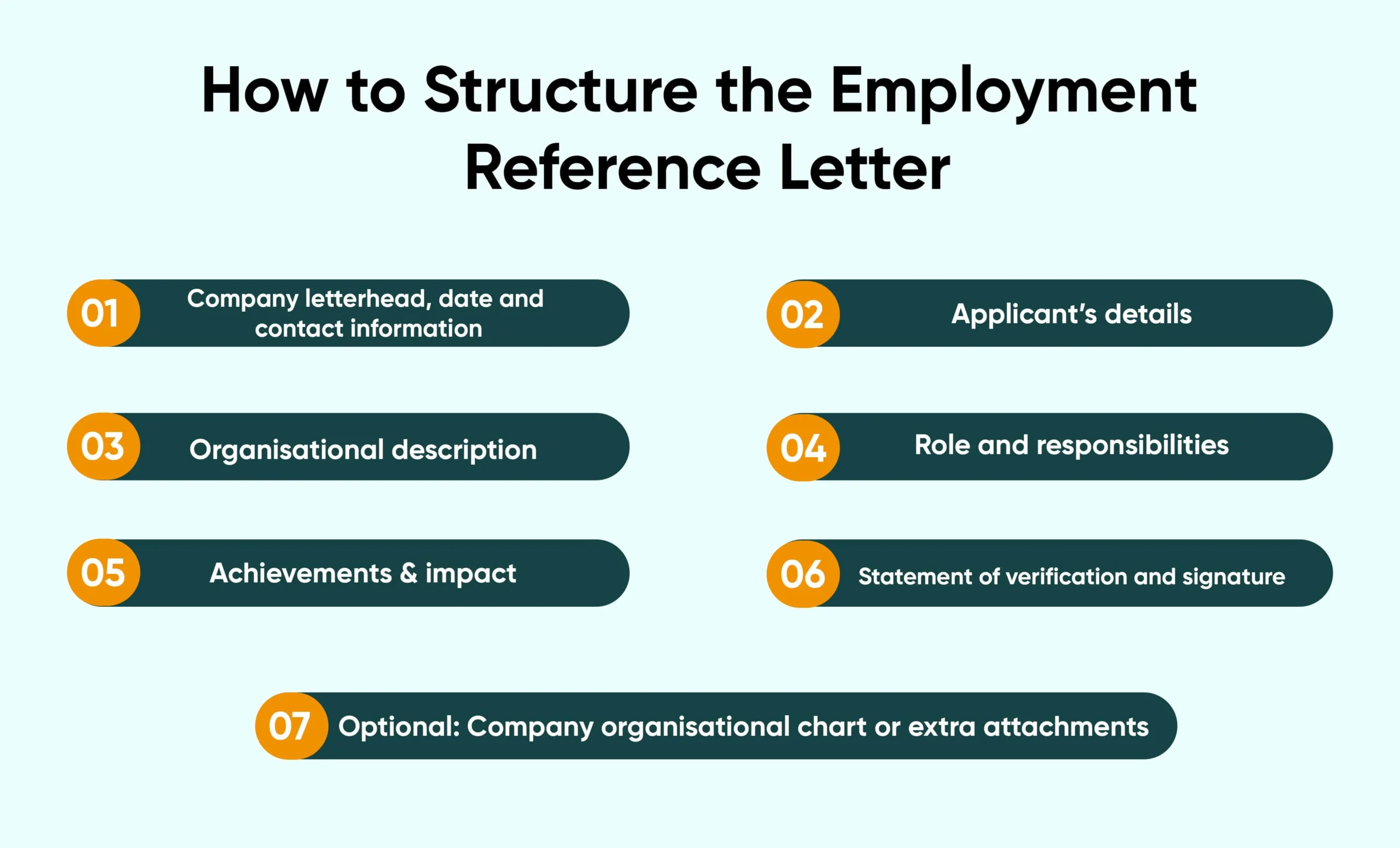
A reference letter for IML ANZ should follow a clear, professional structure and must align with the assessing authority’s expectations. Here’s a recommended structure:
1. Company letterhead, date and contact information
- Use the employer’s official letterhead (logo + address)
- Date of issue of the letter
- Name and contact details of the person issuing the letter (ideally HR or direct supervisor)
- Their position/title, and a statement of authorisation (i.e., they are authorised to verify employment details)
2. Applicant’s details
- Full name of the applicant (as per passport)
- Applicant’s job title while employed
- Employment period: start date and end date (or “ongoing” if still employed)
- Employment status (full-time/part-time/contract)
- Location of employment (city/country) if relevant
3. Organisational description
- Brief description of the organisation: e.g., type of business, number of employees, its scale/size, market region
- Reporting structure: who the applicant reported to, whether they managed teams and who reported to them (e.g., number of direct reports). This helps contextualise the managerial role.
4. Role and responsibilities
This is the heart of the letter. It should clearly describe the main duties the applicant performed, emphasising leadership, management, strategy, budget, staff supervision, decision-making, etc. Use bullet points or paragraphs that:
- Map duties to managerial functions: e.g., developing strategic plans, managing budgets, supervising staff, leading projects, and stakeholder management
- Provide quantitative detail where possible: e.g., “Managed a team of 12”, “Oversaw budget of AUD 2 million”, “Led cross-functional project involving 3 departments”
- Show timeline or progression: e.g., “Initially responsible for X, then promoted to Y”
- Show scope: e.g., “Global region”, “Asia-Pacific market”, “multiple sites”.
5. Achievements & impact
Rather than only listing duties, highlight achievements and results. This emphasises that the role was substantive and influential. For example:
- “Increased sales by 20% within the first year through implementing new market segmentation.”
- “Reduced operational costs by 15% by redesigning the supply chain process.”
- “Spearheaded merger integration of two business units, delivering synergy savings of AUD 500k.”
6. Statement of verification and signature
- A statement confirming that the applicant did perform the stated role, to the best of the writer’s knowledge, and that the details are true and correct
- Signature of the authorised person issuing the letter
- Printed name, job title, company name, contact phone/email
- Company stamp (if applicable)
- Some letters include their willingness to be contacted for verification.
7. Optional: Company organisational chart or extra attachments
While not always included in the letter itself, some applications attach a small organisational chart or note that such an attachment is available on request. It can strengthen the evidence of the reporting structure.
Summary of structure
Putting together:
- Header (letterhead + date + contact)
- Applicant’s identity & employment period
- Company/organisation description
- Role description (duties)
- Achievements (results)
- Verification statement + signature
- Optional attachments.
Next, let’s move to what must be included and what to avoid, with a specific focus on the IML ANZ context.
What to Include in Your Employment Reference Letter for IML ANZ
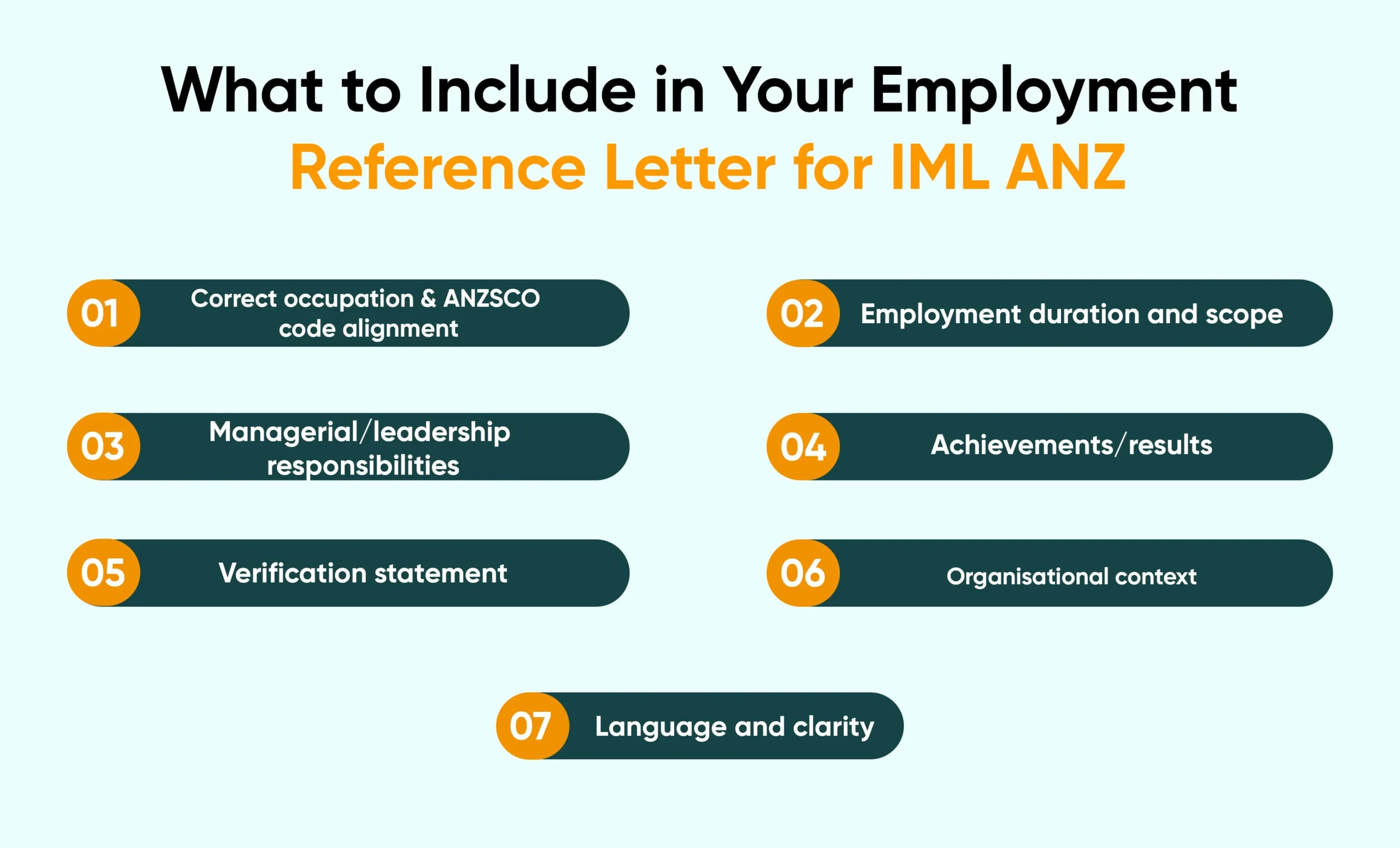
Here are key elements that your reference letter should cover, to align with what IML ANZ expects from the employment evidence.
Key element 1: Correct occupation & ANZSCO code alignment
- Clearly align your position title and duties with the nominated ANZSCO code (for example, Chief Executive (111111) or Corporate General Manager). (111211) and check that your role description fits the ANZSCO definition.
- In many cases, the ANZSCO definitions emphasise tasks like “establishing strategic direction”, “managing operations or business unit”, “overseeing budgets and staff”, etc. The letter should reflect such tasks.
- If you changed roles, include the timeline and show progression.
Key element 2: Employment duration and scope
- Full start and end dates (day, month, year) or at least month & year.
- If still employed, use wording like “from 01 February 2018 to present”.
- State your employment status (full-time, part-time).
- Provide clear dates and avoid “circa” or “approximate”.
Key element 3: Managerial/leadership responsibilities
- Confirm that you had direct reports and/or supervised staff. E.g.: “Managed a team of 10 engineers and 2 team leads.”
- Confirm budget responsibility: “Responsible for the annual budget of AUD 3 m.”
- Confirm decision-making authority: “Responsible for approving supplier contracts up to AUD 500k”, etc.
- Confirm strategic involvement: “Contributed to business unit strategic plan 2023-25”, “Led global operational excellence programme across regions.”
- Confirm scope: region (domestic/international), business unit size, number of staff or revenue or cost centre size.
Key element 4: Achievements/results
- Demonstrate outcomes of your leadership: KPIs, metrics, process improvements, revenue growth, cost savings, market expansion, new product launch, etc.
- Provide specific numbers where possible, and make the claim strong and credible. Avoid vague statements like “helped improve performance”.
Key element 5: Verification statement
- The person writing the letter should confirm that, to the best of their knowledge, the applicant performed the duties described.
- Provide their name, title, contact, signature, and date.
- Confirm availability for contact if necessary.
- Use company letterhead and appropriate format.
Key element 6: Organisational context
- Explain how the applicant fits into the organisation’s hierarchy, e.g., “reports to the Managing Director” or “heads the Operations Division under the Regional Director for APAC”.
- Optionally include an organisational chart reference.
- Provide company size: number of employees or turnover (approximate) or global footprint to show scale of role.
Key element 7: Language and clarity
- The letter must be in English (or accompanied by a certified English translation).
- Use clear professional language. Avoid managerial jargon that may not translate globally.
- Ensure there are no inconsistencies with other documents (CV/resume, application, dates).
- Avoid ambiguous wording such as “involved in” or “assisted with”; you want “responsible for”, “led”, or “managed”.
Example of key crafted sentences
- “Mr X was employed full-time as Senior Operations Manager from 01 March 2019 to 31 December 2023.”
- “In his role, he managed a direct team of 12 and an indirect team of 35 across two countries (India & Sri Lanka).”
- “He was responsible for the annual operations budget of AUD 4.2 million and had authority to approve supplier contracts up to AUD 250,000.”
- “He prepared the divisional strategic plan, set performance targets, and monitored key performance indicators (KPIs) quarterly.”
- “During his tenure, he led a cost-reduction programme that delivered annual savings of AUD 600k and improved on-time delivery from 87% to 96%.”
Common Mistakes to Avoid

Even a well-intentioned reference letter can fail to meet standards if certain mistakes are made. Here are common pitfalls to avoid for your IML ANZ reference letter.
Mistake 1: Vague or generic language
Statements like “was part of the team”, “assisted with”, and “helped in” are weak. They suggest a lack of autonomy or leadership. IML ANZ expects clear evidence of managerial capacity, not just involvement.
Mistake 2: Missing dates or unclear employment status
Using “2018 – present” can be acceptable if still employed, but avoid “since 2018 approx.” or “2018 onwards”. The letter should clearly identify the employment period.
Mistake 3: Inconsistent job titles, duties, or reporting lines
Ensure your employment reference letter matches your résumé/CV and other documents exactly (job titles, start/end dates, responsibilities). Inconsistencies raise red flags.
Mistake 4: No quantifiable achievements or scope
If the duties are described but no scale or outcome is given (team size, budget, or region), it weakens the case. IML ANZ assessors need to see the scope of management.
Mistake 5: Unsigned or unverified letter
Avoid letters that are merely signed “HR Department” with no name, signature or contact. Letters must be verifiable. Some letters from small companies use non-official letterhead or lack authorisation.
Mistake 6: Poor organisation or lack of clarity
A letter that is hard to read, poorly structured, or includes irrelevant information can create doubt. Stick to relevant managerial duties. Avoid including non-management tasks unless they show leadership.
Mistake 7: Language errors or translation issues
If the original letter is in another language, the English translation must be certified. Poor translation quality may undermine credibility.
Practical Tips to Prepare a Strong Employment Reference Letter
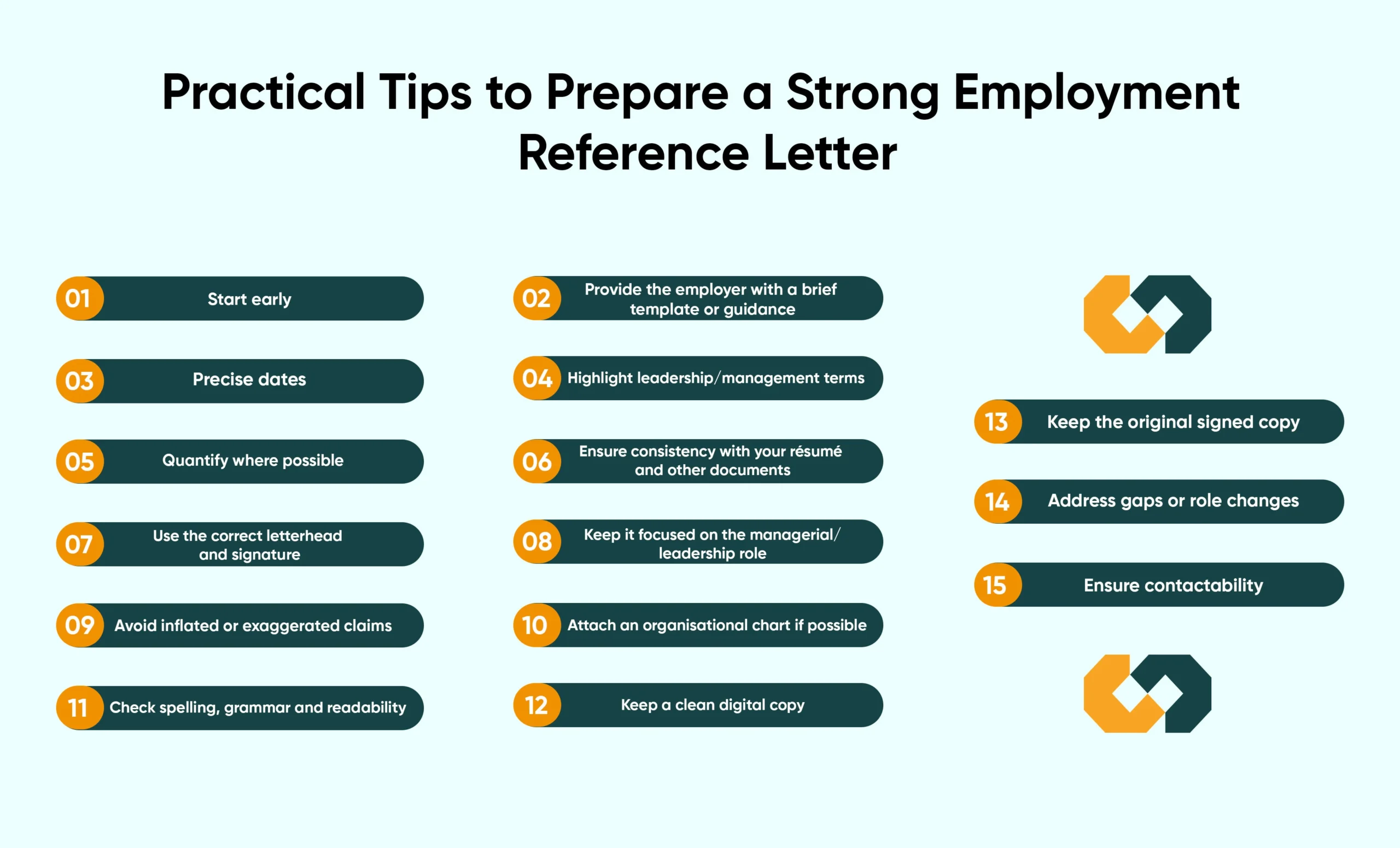
Here are actionable tips to improve the quality and effectiveness of your reference letter for the IML ANZ skill assessment.
1. Start early
Don’t wait till the last minute. Request the reference letter from your employer with sufficient time.
2. Provide the employer with a brief template or guidance
Many employers may not have experience writing such letters for migration assessments. You can draft a suggested version (with their input) and ask them to edit and approve.
3. Precise dates
Ensure the letter uses a clear day/month/year or at least month/year.
4. Highlight leadership/management terms
Words such as “managed”, “led”, “supervised”, “approved”, “strategic”, “oversaw”, “direct reports”, and “budget responsibility” should be used.
5. Quantify where possible
Team size, budget amounts, number of regions, savings, and revenue growth. These add weight.
6. Ensure consistency with your résumé and other documents
Avoid discrepancies in titles, dates, and duties. All documents should tell the same story.
7. Use the correct letterhead and signature
It should be printed/scanned (or PDF) on the company letterhead, with the signature of a person in a senior/appropriate role (HR manager, supervisor, director).
8. Keep it focused on the managerial/leadership role
Avoid unrelated tasks that do not show leadership capability.
9. Avoid inflated or exaggerated claims
If challenged, the employer may be asked to verify. Honesty and accuracy matter.
10. Attach an organisational chart if possible
If you can attach or reference a simple org chart, it gives clarity of your position in the company hierarchy.
11. Check spelling, grammar and readability
Errors can undermine credibility.
12. Keep a clean digital copy
Ensure the scanned version is clear, legible, full page, no missing parts and good resolution.
13. Keep the original signed copy
In case you need to respond to queries from IML ANZ, having the original signed letter is safer.
14. Address gaps or role changes
If you had multiple positions, ask for separate letters or a letter that clearly explains progression and responsibilities over time.
15. Ensure contactability
The letter should provide a phone number or email of the signatory so IML ANZ can verify if required.
Sample Employment Reference Letter for IML ANZ Assessment Templete 1
Below is a template you can adapt for your own employment reference letter. Be sure to customise it to your individual role, company, dates, achievements, and scale.
[Company Letterhead]
Date: 12 August 2025
To Whom It May Concern,
Subject: Employment Reference for [Applicant Full Name] (Passport No: XXXXXXXX)
This letter is to confirm that [Applicant Full Name] was employed by [Company Name], headquartered at [Address], from 01 March 2019 to 31 May 2025 as Senior Operations Manager (full-time).
During his/her tenure, [he/she] reported directly to the Regional General Manager for Asia-Pacific and had overall responsibility for the Operations Division covering three countries (India, Sri Lanka and Bangladesh).
The company is a multinational manufacturing firm with approximately 3,500 employees and an annual revenue of AUD 150 million.
In his/her role, [Applicant] performed the following key responsibilities:
- Managed a direct team of 12 and an indirect team of 38 staff across two shifts in two production sites.
- Held budgetary accountability for the operations cost centre of AUD 4.2 million annually.
- Approved supplier contracts up to AUD 250,000 and led vendor negotiations to deliver cost savings.
- Developed and executed the 2021-2023 operational strategic plan, including initiatives for lean manufacturing, supply-chain optimisation and team competency development.
- Monitored and reported key performance indicators (KPIs) monthly to senior management and improved on-time delivery from 87% to 96% and reduced rejects by 22% in the 24 months.
- Led the integration of a newly acquired subsidiary operation in Sri Lanka, completed within 10 months and achieved synergy savings of AUD 600,000.
Throughout the employment period, [Applicant] demonstrated strong leadership, strategic thinking, excellent stakeholder management and consistent delivery of results in a complex, multi-country environment. [He/She] had full managerial authority over the Operations Division and was the key decision-maker for performance improvement initiatives.
I confirm that, to the best of my knowledge, the details contained in this letter are true and correct. Should you require any further information, please feel free to contact me.
Yours sincerely,
(Signature)
[Name of Signatory]
Human Resources Director
[Company Name]
Phone: +61 2 XXXXXXXX
Email: hr@[company].com.au
[Company Stamp]
Employment Reference Letter Template 2
Here’s a simplified reference from the employer template for Australian immigration:
[Your Name][Your Address]
[Date]
To Whom It May Concern,
I confirm that [Employee Name] worked at [Company Name] as a [Job Title] from [Start Date] to [End Date]. Their role involved [List Key Responsibilities], and they consistently delivered high-quality results. [Employee Name] demonstrated strong leadership, communication, and problem-solving skills, making significant contributions to our team’s success.
Please do not hesitate to contact me for further details.
Sincerely,
[Your Name and Signature]
[Company Name]
Notes on this sample:
- It uses full dates and managerial terminology and quantifies team size, budget, and improvements.
- It describes the organisational context (multinational, number of employees, revenue).
- It includes the signatory’s name, title, contact details, and a verification statement.
- It is clearly tailored to a managerial role, aligned with the kind of evidence IML ANZ expects.
How the Reference Letter Fits into Your Overall IML ANZ Application
Understanding where the employment reference letter fits into your overall IML ANZ skill assessment application will help you see its importance and ensure consistency across documents.
Step-by-step: Application flow and the role of reference letters
- Select your nominated occupation and verify eligibility — check your ANZSCO code and confirm IML ANZ is the correct assessing authority.
- Gather supporting documents — this includes your qualification certificates, CV/resume, employment reference letters, organisational charts, payslips/tax records (where required) and any leadership statements.
- Prepare your application — fill the online form, pay the fee, and upload documents. The employment reference letter is uploaded under the section for employment evidence.
- Assessment by IML ANZ — the assessing body will review your employment references, among other documents, and evaluate whether your experience meets Australian managerial standards. Incomplete, weak, or inconsistent employment letters can delay or negatively affect the outcome.
- Outcome letter — If successful, you receive a positive skills assessment outcome letter, which you use for your visa application. If there are issues with employment evidence, you may receive a negative outcome or be asked for further evidence.
- Use in a visa application — For your visa to Australia (such as subclass 189, 190, or 491), you may need to submit the outcome of the skills assessment. A strong reference letter helps ensure you get that positive outcome.
Ensuring consistency across documents
- The dates and job titles in the reference letter must match your CV, payslips, and contracts.
- The responsibilities described must correspond to what you claim in other parts of the application.
- Quantitative claims should correspond with what you might present elsewhere (for example, in your résumé or summary statement).
- Avoid contradictions: e.g., your CV says you started in 2018, and the reference letter says 2019. This will raise a red flag.
Aligning your reference letter with the ANZSCO occupation definition
When you choose your nominated ANZSCO code (for example, 111111 Chief Executive or Managing Director), it comes with a defined set of tasks and requirements.
It’s appropriate that your reference letter’s responsibilities reflect those tasks. IML ANZ expects that the applicant indeed performed the tasks associated with the nominated code.
Reviews of the IML ANZ checklist emphasise “evidence of management or leadership experience”. Therefore, craft your letter so that your duties map credibly to those required by the ANZSCO definition.
Checklist for Employment Reference Letter (IML ANZ)
Here’s a quick checklist you can use before submitting to ensure your employment reference letter meets required standards.
- Official company letterhead used
- Date of letter clearly stated
- Applicant’s full name and job title included
- Employment period clearly stated (start date – end date/present)
- Employment status (full-time/part-time) is clearly stated
- Reporting structure is described (who you reported to, who reported to you)
- Company size/scale/context described (employees, revenue, business units)
- Duties aligned with managerial/leadership functions (e.g., staff supervision, budgets, strategic planning)
- Quantified scope/metrics (team size, budget amount, region, results achieved)
- Achievements/results described (improvement, savings, growth)
- Verification statement (the letter writer confirms accuracy)
- Name, title, signature, and contact details of the signatory
- Attachments or references to the organisational chart, if applicable
- Language: Clear, English, free of errors, and leadership terminology used
- Consistency with other application documents (CV, dates, titles)
- Prepare a digital copy (scanned, good resolution) and keep the original signed version
- If the original letter is not in English, include a certified translation
- Collected sufficiently early to allow for delays or queries
Example Walk-Through: How to Write the Letter Step-by-Step
Here, we’ll walk you through how you might go about writing or reviewing your employment reference letter step by step.
Step 1: Gather the factual information
Start by gathering:
- Your exact start and end date, or “to present” if still employed
- Your official job title(s) and any promotions during employment
- The name and title of your immediate supervisor(s)
- Number of direct/indirect reports you managed
- Budget amount you were responsible for (if any)
- Key strategic initiatives, achievements you delivered
- The business unit or department size, region, and number of employees
- The signatory: name, title, contact info of HR or senior manager who will sign the letter
Step 2: Offer the employer a draft or guidance
Because many employers may not be familiar with migration-skill assessment letters, you may provide them with a draft or outline that they can edit. This saves them time and ensures the letter covers necessary items. But ensure you obtain their full approval and that the final signed version is on their letterhead.
Step 3: Write the letter content
Using the gathered information, draft the letter:
- Opening: “This letter is to confirm that … was employed by … from … to … as … (job title) at the company …”
- Context: “The company is … with X employees and revenue of …”
- Role: “In this role, [the applicant] reported to … and had responsibility for the Operations Division covering …”
- Duties: Use bullet points to list duties showing leadership/management functions
- Achievements: follow the duties with key achievements/outcomes
- Verification: “I confirm that to the best of my knowledge the above is true…”
- Signatory details: name, title, contact, signature, company stamp.
Step 4: Review and edit
- Check spelling, grammar and clarity
- Confirm use of leadership language (“managed”, “led”, “oversaw”, “approved”, “direct reports”)
- Ensure coefficients (numbers) make sense and are realistic
- Cross-check dates, job title, and contractual title with your CV and other documents
- Ask the signatory to verify, sign and provide contact details.
Step 5: Scan and keep originals
- Once signed, scan a high-resolution PDF/colour image version for your submission.
- Keep the original signed hard copy safe in case you are asked to provide further verification.
- Ensure any scanned version clearly shows the letterhead, signature and stamp (if any).
Step 6: Upload with your IML ANZ application
- Add the reference letter in the employment evidence section of your application.
- Ensure the naming of the file is clear (e.g., “EmploymentReference_ApplicantName_CompanyName_2019-2025.pdf”).
- Double-check that all other documents (CV/resume, payslips/tax records, organisational chart) correspond with the reference letter.
FREE CDR SAMPLE!
Get Free CDR Report Samples
Frequently Asked Questions (FAQs)
Here are some common questions about employment reference letters for the IML ANZ skills assessment.
Q1: Does the letter need to be notarised or certified?
A: For IML ANZ, the letter should be on official company letterhead, signed by an authorised person and include contact details. Generally, no notarisation is required unless specified.
Some applicants also provide a company stamp. If the letter is a copy, ensure the original signed version is kept. Always check the specific checklist for your assessing authority.
Q2: Can I prepare the draft and ask the employer to sign it?
A: Yes, many applicants provide a draft for the employer’s convenience. However, you must ensure the final version is reviewed, authorised and signed by the employer and accurately reflects your role.
It must not be obviously self-written without employer input.
Q3: What if I held multiple managerial roles at the same company?
A: If you had distinct roles with different responsibilities (for example, Manager → Senior Manager → Director), you may either request separate letters for each role or one comprehensive letter which outlines the timeline of progression, role changes, responsibilities and achievements.
Ensure clarity on dates and duties for each role.
Q4: What if my company is small or doesn’t have formal letterhead?
A: Even smaller companies can provide a valid letter and ensure the letter includes the company name, address, job dates, role description, and signatory details and is on company stationery if possible.
If the company lacks a formal letterhead, you might provide a letter typed on an official company printout with the company stamp and signatory details. Attachments like a company registration certificate or a business profile can help strengthen context.
Q5: Do I need to send payslips/tax records along with the letter?
A: While the reference letter is primary evidence of employment and managerial role, paying authorities (including IML ANZ) may ask for supplementary evidence such as payslips, tax returns, or contracts to verify employment. It’s prudent to gather these early.
Q6: What if the letter is not in English?
A: If the original letter is in another language, a certified English translation must be provided along with the original. The translation should be done by a registered translator and include the translator’s name, signature and date.
Q7: How many reference letters do I need?
A: The exact number depends on your work history and how many managerial roles you are presenting. At a minimum, you must provide reference letters covering all the employment claimed in your application for the nominated occupation.
If you present 5 years of managerial experience, you may need one or multiple letters, depending on job changes.
Conclusion: Why Investing in a Quality Employment Reference Letter Pays Off
In summary, your employment reference letter for the IML ANZ skill assessment is not just an administrative piece of paper; it’s a strategic document that can make or break your application.
Because IML ANZ is assessing your managerial capabilities, not simply your job title, the more you can show clarity, leadership, scope, achievement and responsibility, the stronger your case.
Putting effort into drafting, reviewing, and verifying this letter helps you:
- Show that your employment narrative is credible and consistent
- Align your experience with the managerial/leadership duties required by your ANZSCO code
- Provide clear, verifiable evidence to the assessing authority.
- Reduce the risk of queries or negative outcomes due to weak employment evidence.
- Speed up your migration journey to Australia by presenting a strong application.
If you follow the structure, include the key elements, avoid common mistakes and heed the practical tips above, you’ll be well-positioned to present a strong employment reference letter for your IML ANZ application.
